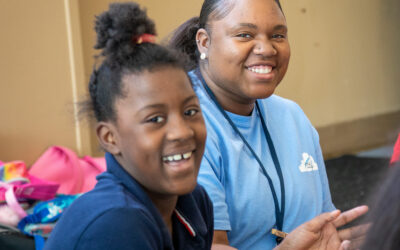

Engaging children in conversations provides everyday moments to deepen social emotional learning. In individual and group settings, prompting a conversation can boost student engagement that builds trusting relationships so students feel comfortable sharing with you and their peers. When you ask children questions, you are giving them the opportunity to reflect and think deeply about their feelings and perspectives.
Also referred to as a conversation starter, Discussion Prompts are open-ended questions that help students think more deeply about the lessons and skills they are learning. Prompting a conversation is just like it sounds: it’s something you say to spark a conversation and help the student build a skill.
Asking relevant discussion questions allows students to get to know one another and explore their commonalities and differences. They can also promote problem-solving, cooperation, and collaboration. By prompting conversations with children, you can:
- Engage students in learning
- Challenge them to make connections to lessons within their own life
- Teach more than one skill at a time
- Demonstrate practical application of social emotional skills

Discussion Prompt Examples
Topic: Identity
Competency: Self-Awareness
Prompt: Think of two people you know. What do you have in common with them? What makes each one of you unique?
Topic: Impulse Control
Competency: Self-Management
Prompt: Describe a mistake you may have made because of rushing without stopping to think. How can taking your time and planning help avoid future mistakes?
Topic: Responsibility
Competency: Responsible Decision-Making
Prompt: What is a new responsibility that you want to have? How can you show that you are ready?
Topic: Generosity
Competency: Social Awareness
Prompt: Describe a time when someone shared something with you or helped you when the person did not have to. How did it make you feel?
How To Implement Discussion Prompts
Using Discussion Prompts is just another way to turn an everyday moment into a teachable moment. Feel like you just witnessed a teachable moment? Be spontaneous! Ask children to reflect on what happened in the moment with a stimulating question anytime during the day.

Before, During or After Activities
Try starting a conversation after playing a game, during arts and crafts time, or out on the playground at recess.
“What helped you work together during this activity?”
“What different emotions did you feel throughout this activity?”
When Giving Praise
Prompt a child to think about the connection between their positive behavior and a social emotional lesson they may have learned or are learning with a thought-provoking question.
“I loved having all of your support today. What are some ways you can support a friend or family member during your day?”
Before, During or After Reading Time
Books are an excellent segue into starting a discussion with students. Use these thought starters to help formulate questions to ask the next time you read I Soar with Wings, or any book, aloud:
- Consider how the characters feel.
- Discuss how a character could solve a problem and what that process might look like.
- Talk about what a character might be thinking and how it is affecting their decision making.
- Brainstorm the characteristics that make someone a good friend.
- Analyze what a character is doing that affects others positively or negatively.
When Working In a Group
Building trust and positive relationships in group settings helps to create safe spaces for learning. When students feel psychologically safe, they’re more likely to participate in class discussions and ask questions. Having conversations when working with groups can help build stronger relationships, increase skill building, and foster positive learning environments.
“Everyone was surprised when it started to rain and we weren’t able to go outside and play. Let’s share some ways we can calm ourselves down when surprises happen.”
Tips For Effective Facilitation and Implementation
- Positively reinforce student contributions. You can emphasize the value of student responses by restating their comments, writing their ideas on the board, and/or making connections between their comments and the discussion at large.
- Be sure to maintain eye contact and use non-verbal gestures such as smiling and head nodding to indicate your attention and interest in students’ responses.
- Allow students to ask questions or share ideas in class anonymously. When applicable, circulate note cards for students to write questions or comments, or to answer your discussion prompts anonymously.
- Give students low-stakes opportunities to think and discuss lessons and skills – this is a “tolerance for error” approach. Students sometimes need to get it wrong, take risks, or try out different ideas to learn.
- Try facilitating smaller discussions among students before you ask them to share with the entire class. Many students need some time and space to try ideas out with one another first. This also gets more students talking.
- Try organizing smaller activities before discussion and questions start, so that students have time and space to compose their thoughts. For example, to help them prepare for discussion, give them the opportunity to write or solve problems quietly for a few minutes. You might even consider asking students to pass these ideas around the room to share with one another, as long as you have warned them in advance that you will do so.
Discussions around SEL competencies and skills can help students solidify concepts they may otherwise have a hard time understanding. Rather than passively delivering information, class and group discussions encourage students to process it as well. This can foster critical thinking skills and help students understand concepts more thoroughly.
These discussions also expose students to new ideas and perspectives. As your students feel more comfortable sharing their opinions, they’ll likely find that their classmates and friends hold perspectives that are different from their own. In this way, discussions can open students to see topics from a new angle and develop richer opinions.