Trust is essential for building healthy peer relationships, creating a positive classroom community, and developing emotional safety. When children understand how to be trustworthy friends, they’re better equipped to form meaningful connections, resolve conflicts peacefully, and contribute to an inclusive environment where everyone feels valued and secure.
Time Required:
20-25 minutes
Materials Needed:
- Chart paper, chalkboard, or whiteboard
- Markers or chalk
- Grades K-2: Small building blocks or stackable cups
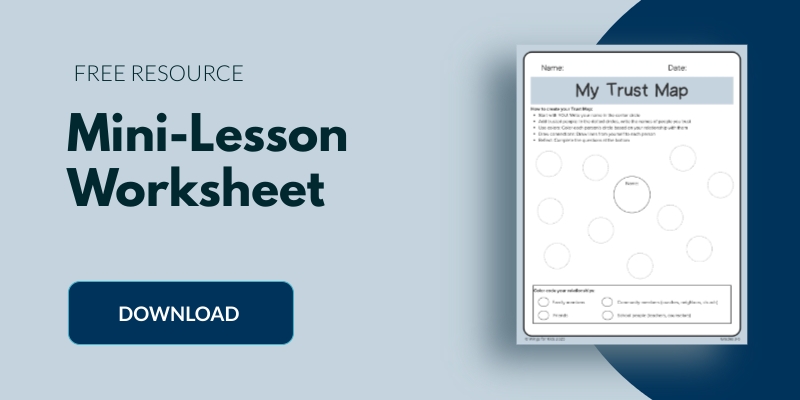
- Grades 3-5: “My Trust Map” printable worksheet (2-sided)
Grade-Specific Activities
Grades K-2: “Trust Building Blocks”
Opening Introduction (3-4 minutes)
“Today we’re going to talk about something super important for friendship – trust! Raise your hand if you’ve heard the word ‘trust’ before.”
*Wait for responses*
“Trust is like a bridge between friends. When we trust someone, we believe they will do what they say they’ll do, and we feel safe with them. When someone trusts us, they believe we’ll be a good friend to them too.”
“Let’s think about trust like building blocks! When we do trustworthy things, we add blocks to our friendship tower. When we don’t keep our promises or aren’t kind, blocks might fall down. But the great news is we can always rebuild!”
Activity (10-12 minutes):
Brainstorm together: “What does a trustworthy friend do?” Kids raise their hand to share their thoughts as an adult writes responses on chart paper.
- Examples: Keeps promises, tells the truth, shares, helps when someone is hurt, keeps secrets safe, includes others
Building Blocks Game:
- Use blocks or stackable cups to build a “Trust Tower”
- For each trustworthy behavior mentioned, add a block or stack a cup (creating a triangle shape)
- Act out positive scenarios: “If your friend tells you a secret, what would a trustworthy friend do?” Add blocks to represent the building of trust.
Trust Broken Scenario: “Let’s say Maya promised to play with Sam at recess, but then Maya decided to play with someone else instead and didn’t tell Sam. What happens to our trust tower?” Remove some blocks to show trust falling down
Rebuilding Discussion: “The good news is Maya can rebuild trust! What could Maya do to fix this?” Add blocks back as students suggest solutions like apologizing, explaining what happened, and making a new plan to play together
Group Reflection Activity: Have kids share out loud or with a partner. “Think of someone you trust. What makes them trustworthy?”
Discussion Questions (5-6 minutes):
- “How do you feel when someone keeps a promise to you?”
- “What happens when someone you trust does something that hurts your feelings? Can trust be fixed?”
- “How can we show others that we’re trustworthy friends?”
Closing (2 minutes):
“Remember, being trustworthy means others can count on us to be kind, honest, and caring. Every day, we get to choose to add blocks to our friendship towers. What’s one trustworthy thing you want to do today?”
Grades 3-5: “Trust Circles”
Introduction (2 minutes):
“Trust is the foundation of all strong friendships and communities. It’s built through our actions over time – both big and small. Today we’ll explore what trust looks like in different situations and how we can be trustworthy community members.”
Activity (12-15 minutes):
Scenario Discussions: Present real-life scenarios for small group or whole class discussion:
- “Your friend asks you not to tell anyone they’re trying out for the school play, but another classmate asks you directly about it.”
- “You promised to help your teammate practice for the game, but your family planned something fun at the same time.”
- “You accidentally broke something that belongs to a classmate.”
Trust Mapping:
- Download, print and handout the trust map worksheet
- Students work in pairs to create a “trust map” showing different people they trust (family, friends, teachers, community members)
- Discuss what makes each relationship trustworthy
Community Trust Building: Brainstorm ways the class can build trust together as a learning community
Discussion Questions (6-8 minutes):
- “Why might trust be especially important in our diverse classroom community?”
- “How can we rebuild trust when it’s been damaged?”
- “What’s the difference between being trustworthy and trusting others? Why does both matter to have a strong relationship?”
- “How does being trustworthy help everyone in our class feel safe and included?”
Closing (2-3 minutes):
“Trust takes time to build and can be fragile, but it’s one of the most valuable gifts we can give each other. In our classroom, we’re all responsible for creating a community where everyone feels safe to be themselves. What’s one specific way you’ll show trustworthiness this week?”
Additional Activities
For All Grades:
- Classroom Trust Agreements: Collaborate to create class agreements about how to build and maintain trust
- Trust Appreciation: Weekly opportunity for students to recognize trustworthy actions in peers
More Ideas:
- Partner with families by sending home conversation starters about trust
- Connect to literature by reading books that feature trust themes
- Role-play challenging trust scenarios to practice problem-solving
Key Takeaways for Educators
This lesson helps students understand that trust is:
- Built through consistent, caring actions
- Essential for creating inclusive communities
- Something that can be repaired when damaged
- A responsibility we all share in our relationships
By focusing on behavioral choices rather than character judgments, students learn they have agency in building trustworthy relationships while developing empathy for others’ experiences of trust and safety.